How can you use social media to improve your SEO?
It is one of the great debates on the web: does social media have a direct impact on a website's ranking in Google?
The technical answer is no. Google has said several times that social signals (likes, shares, follower counts) are not direct ranking factors. Links posted on Facebook, LinkedIn or X (formerly Twitter) are also generally “nofollow”: they pass no popularity (PageRank) to your website.
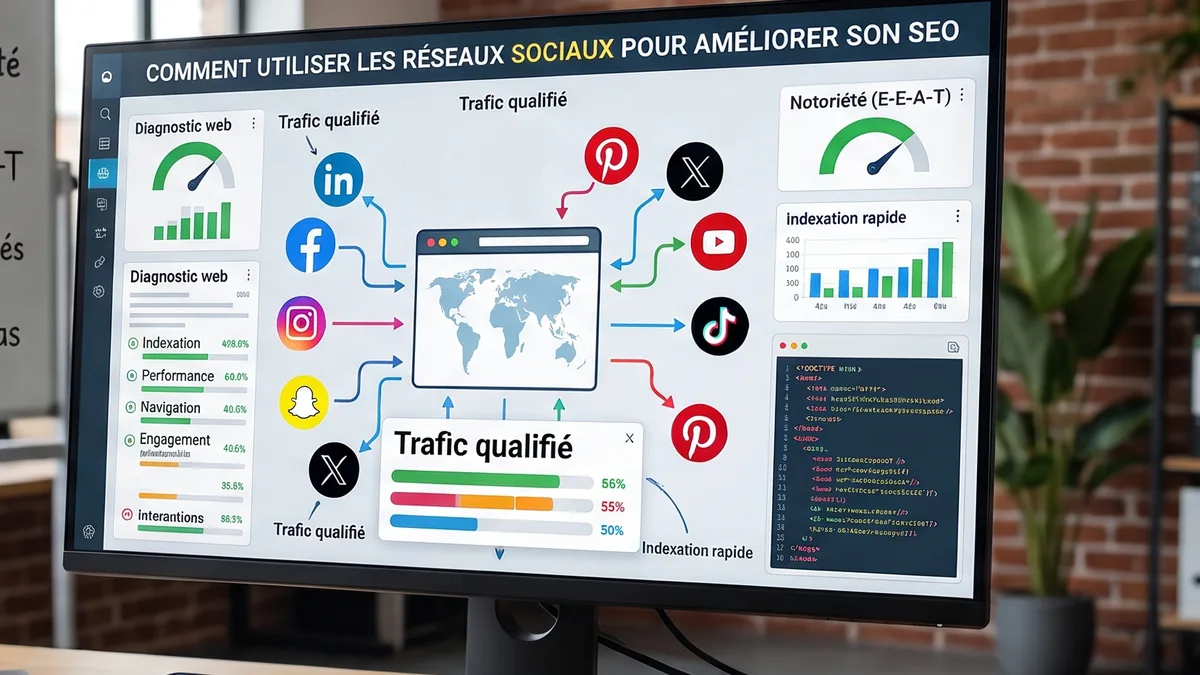
Even so, social media is one of the most effective indirect levers for your SEO. On a web where Google values brand awareness and human proof (the E-E-A-T criteria), keeping it separate from your SEO would be a shame. Here is how to turn your posts into fuel for your visibility.
1. Multiply your content's visibility to attract natural links
The best content in the world will not rank if nobody knows it exists. This is the virtuous circle:
- The amplification effect: when you publish an article or a case study, share its key points on LinkedIn, Facebook or X. The more your community engages, the further your content travels.
- Naturally earned links: among the people who see your post are bloggers, journalists and website managers. If they find your content useful, they will cite it on their own pages. These external links (backlinks) are what strengthen your website's authority in Google's eyes.
2. Generate qualified traffic and build brand awareness
Google does not read your social media statistics or your analytics tool. But the attention you create turns into behaviour that does count.
- Direct traffic and brand searches: social networks send visitors to your website and, above all, make your name stick. Someone who discovered you on Instagram often ends up typing your company name into Google. These brand searches are a good indicator of awareness, and they lead straight to clicks on your website.
- Engaged visitors: if people coming from your social channels read your content, browse your products and come back, it shows your website meets their expectations. Track it in Google Analytics 4: it is the best basis for improving your pages and conversions.
3. Optimise your profiles for search and E-E-A-T
Search engines do not only index websites: your profiles and some posts can appear on the first page, especially for searches related to your brand.
- Social search: YouTube, TikTok, LinkedIn and Pinterest increasingly work as search engines in their own right. By polishing your bios, descriptions and hashtags with the terms of your trade, you capture extra traffic. That is what social media optimisation (SMO) is all about.
- Proving who is behind the website: with AI-generated content multiplying, Google seeks to highlight real experts. Active company and author profiles, linked to your website, with genuine interactions, make your expertise more visible and more credible, an asset for E-E-A-T, including with AI answer engines.
4. Get your new pages discovered faster
For Google's crawlers, discovering a new page can take anything from a few hours to several weeks.
Sharing your new content on your active social channels makes it known straight away, and everyone who picks it up on their own website or blog creates a new path to your pages. For fast and reliable indexing, however, the right reflex is still to list your pages in a sitemap and request indexing in Google Search Console.
Conclusion
SEO and social media should no longer work in silos. Social networks prepare the ground, create awareness and engagement; SEO consolidates that visibility over the long term. Combining the two produces the most effective acquisition strategies.
Would you like content that is easy to share and designed to convert? Contact GUIGOUT SAS to strengthen your brand's technical and social visibility.
Frequently asked questions
Do likes and shares improve my Google ranking?
Not directly: Google says social signals are not ranking factors. Their effect is indirect: more visibility, more natural links and more searches for your brand.
Do links posted on social media count for SEO?
They are generally nofollow and therefore pass no popularity. However, they bring visitors, some of whom may then link to your website from their own.
Which social networks should a business focus on?
The ones where your customers are: LinkedIn for B2B, Instagram, Facebook or Pinterest for visual products, YouTube for demonstrations. One or two well-run networks are better than five left abandoned.

A website, SEO or another request?
Design, redesign, SEO, maintenance, AI assistant or just a question: let's talk. Free quote and quick reply.
Request a quote or contact us