SEO vs AEO: is your website ready to talk to artificial intelligence?
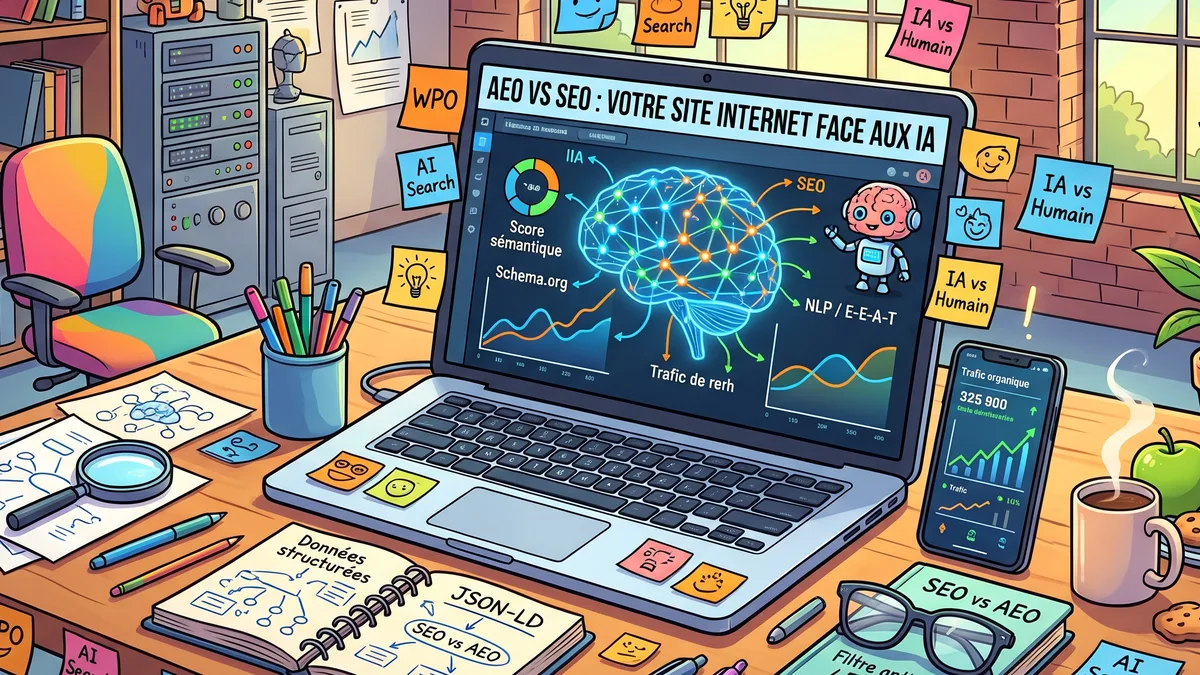
With Google AI Overviews (formerly SGE), ChatGPT Search and Perplexity becoming widespread, the way people search is changing profoundly. We are moving from the era of the “search engine”, which returns a list of blue links, to that of the “answer engine”, which directly synthesises information.
For businesses, this is a paradigm shift. It is no longer just about pleasing Google's traditional algorithm (SEO), but about becoming a preferred source of information for artificial intelligence: this is AEO (Answer Engine Optimization). Here is how to adapt your website to this new landscape.
1. The end of the keyword, the triumph of semantics and entities
For a long time, a basic SEO strategy consisted of repeating a specific keyword in the H1 and H2 tags and the body text. Search engines, and AI even more so, no longer reason in character strings, but in “entities” (a company, a product, a place, a notion) and concepts.
- Natural language processing (NLP): the algorithm understands the overall context of your page. If you sell industrial machine tools, it expects to find a rich and consistent vocabulary: maintenance, numerical control, machining tolerances, safety standards.
- Organising content into topic clusters: to be seen as an expert, your website should not be a pile of isolated pages. It benefits from being structured into logical clusters, linked together and answering the related questions of a given topic.
2. Speak the language of machines: structured data (Schema.org)
Crawlers do not “look” at your page like a visitor: they read its code. The more explicit the information, the easier it is to extract, understand and reuse without error.
- The JSON-LD format: this is the format Google recommends for structured data. Invisible to visitors, this markup tells the machine precisely: “this is a product, here is its price, its availability and its average rating”.
- An asset for AEO: well-built structured data (Organization or LocalBusiness, Product, Article, FAQ…) reduces ambiguity about who you are and what you offer. It does not guarantee being cited, but a clear, well-marked-up website has a head start over a competitor whose information is vague. Note: Google now reserves FAQ rich results for a few official websites, but this markup is still useful to describe your content.
3. The trust filter: E-E-A-T and human proof
Since AI makes it possible to generate thousands of articles in minutes, the web is filling up with worthless synthetic content. In response, Google emphasises E-E-A-T (Experience, Expertise, Authoritativeness, Trustworthiness): strictly speaking, it is not an automatic filter, but the quality framework its raters apply and its algorithms aim to reward, as the September 2026 spam update reminded us.
- Proving experience (the first “E”): AI can write a product sheet, but it has no hands. To stand out, show what it cannot make up: real photos of your projects or products, demonstration videos, verified customer reviews, the signed opinion of an identified expert.
- The brand as a landmark: a genuine digital footprint (detailed author pages, linked LinkedIn profiles, mentions in specialist press) strengthens search engines' trust and increases your chances of being chosen as a source in their answers.
Conclusion
Answer engine optimisation (AEO) does not replace technical SEO: it builds on it. A fast, technically sound and semantically structured website has every chance of becoming prime material for artificial intelligence, at a time when Google Search is becoming Google Answer.
Are your product pages and source code ready to be read by AI? Contact GUIGOUT SAS to audit your technical structure and add the Schema.org structured data that supports your visibility.
Frequently asked questions
What is the difference between SEO and AEO?
SEO aims to rank your pages well in traditional results. AEO aims to make your website a source used in AI-generated answers (AI Overviews, ChatGPT, Perplexity). Both rely on the same foundations: technical quality, good content and trust.
Does structured data guarantee being cited by an AI?
No. It makes your information clearer and easier to use, which helps, but the relevance of your content and the trust placed in your website remain decisive.
Should I write differently for AI?
Write for your customers first: clear answers to real questions, explicit headings, concrete examples and proof of your experience. That is also what AI picks up most easily.

A website, SEO or another request?
Design, redesign, SEO, maintenance, AI assistant or just a question: let's talk. Free quote and quick reply.
Request a quote or contact us