Google's September 2026 spam update: why your traffic moved until 8 October

If you have been watching your Google Analytics or Search Console figures in recent weeks, you may have broken into a cold sweat: sudden spikes, unexplained drops, rankings bouncing up and down from one day to the next.
The most likely cause? Google's September 2026 spam update, launched on 24 September, whose rollout officially ended on 8 October after almost fourteen days. Here is a breakdown of this algorithm adjustment and its consequences for your visibility.
1. Google's goal: cleaning up a saturated web
Since the explosion of generative AI, the web has faced a flood of low-quality content. Spam updates always share the same goal: removing from search results the websites that try to manipulate the algorithms at the expense of users.
Google did not specify exactly what this September update targeted: it applies to all languages and countries, and the company simply refers to its spam policies. These target three fast-growing practices in particular:
- Scaled content: hundreds or thousands of pages generated (by AI or otherwise) with no review, no added value and no expertise, with the sole aim of ranking.
- Expired domain abuse: buying old, reputable domain names to host poor content and benefit from their former authority.
- Site reputation abuse (“parasite SEO”): publishing low-quality third-party content on high-authority websites to take advantage of their standing with Google.
Link spam (buying or exchanging artificial links) has also long been part of these policies.
2. Why did traffic “dance” until 8 October?
An update of this scale is not a switch flipped in a second. It is rolled out gradually, over several days or even weeks.
During this period, pages are re-evaluated in waves and rankings move: when competing websites are demoted, others automatically move up, then positions readjust. It is therefore normal to have seen drops followed by sometimes spectacular rebounds – what SEO specialists call the “Google Dance”. Only once the rollout is complete can reliable conclusions be drawn.
3. The big winners of this update
As with every clean-up, one website's loss is another's gain. A spam update does not directly “reward” good websites: they move up because those that cheated move down. The websites that progress are generally those that respect the fundamentals of healthy SEO:
- Trustworthy content: Google values what it sums up as E-E-A-T (experience, expertise, authoritativeness, trustworthiness). Articles written or reviewed by real professionals in the field, signed and sourced.
- Search intent fulfilled: pages that answer users' questions clearly and quickly, without drowning them in 2,000 words of filler.
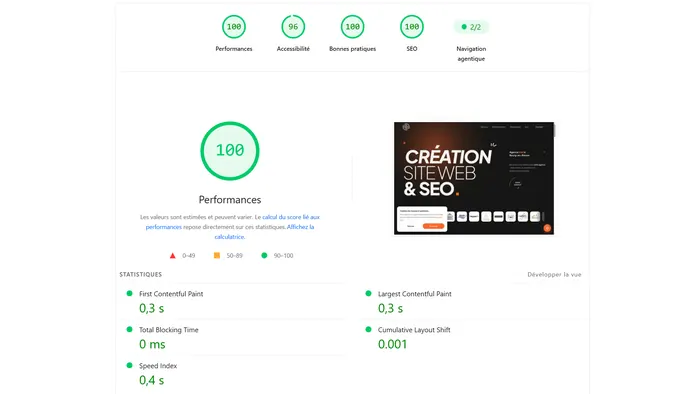
- A sound technical foundation: fast pages and a smooth mobile experience (see our article on PageSpeed and SEO).
4. How to react if your website has lost traffic
If the dust has settled after 8 October and your organic traffic is still clearly down, your website may have been identified, rightly or wrongly, as showing spam or low-quality signals.
The worst reaction would be to rush out fixes. The right approach:
- Isolate the loss: identify in Search Console the pages and queries that lost positions, and check the real impact on your conversions in Google Analytics 4.
- Check for manual actions: a manual penalty has nothing to do with an automatic update, but it appears in Search Console and is handled through a reconsideration request.
- Audit your editorial quality: is your content genuinely useful, unique and written by someone who knows the subject? AI is a good tool, not an autonomous writer (see AI and SEO).
- Check your link profile: make sure no artificial link-building campaign has been run for your website.
Conclusion
Google's algorithms are less and less forgiving of short-term strategies. Building visibility today requires a solid technical foundation, expert content and constant monitoring, with the right SEO analysis tools.
Has your traffic been hit hard by this update and is it not recovering? Contact us for a full SEO audit: together, we will analyse what is holding back your rankings and put a lasting strategy in place to win back your positions.
Frequently asked questions
When did the September 2026 spam update take place?
Google launched it on 24 September 2026 and announced the end of its rollout on 8 October 2026, almost fourteen days later. It applies to all languages and countries.
How can I tell if my website was affected?
In Search Console, compare clicks and positions for the two weeks after 8 October with those before 24 September. A clear, lasting drop concentrated on certain pages is a signal worth analysing.
How long does it take to recover after a spam update?
There is no guaranteed timeframe. Google says that after fixes, its systems may take several months to take improvements into account.

A website, SEO or another request?
Design, redesign, SEO, maintenance, AI assistant or just a question: let's talk. Free quote and quick reply.
Request a quote or contact us