Web eco-design and SEO: when digital sobriety becomes an acquisition lever
For a long time, digital ecology was confined to CSR (corporate social responsibility) reports. In late 2026, it deserves better: an eco-designed website is almost always light, fast and accessible, and Google appreciates those qualities.
To be precise: Google does not measure your website's carbon footprint and has no “ecological” ranking criterion. But eco-design best practices largely overlap with technical SEO. For B2B companies, reducing a website's weight is therefore both a responsible approach and a real acquisition lever.
1. The digital diet: lighter pages, a better-crawled website
Google devotes limited time to crawling each website: this is the crawl budget. It depends mainly on how well your server responds and how valuable your pages are.
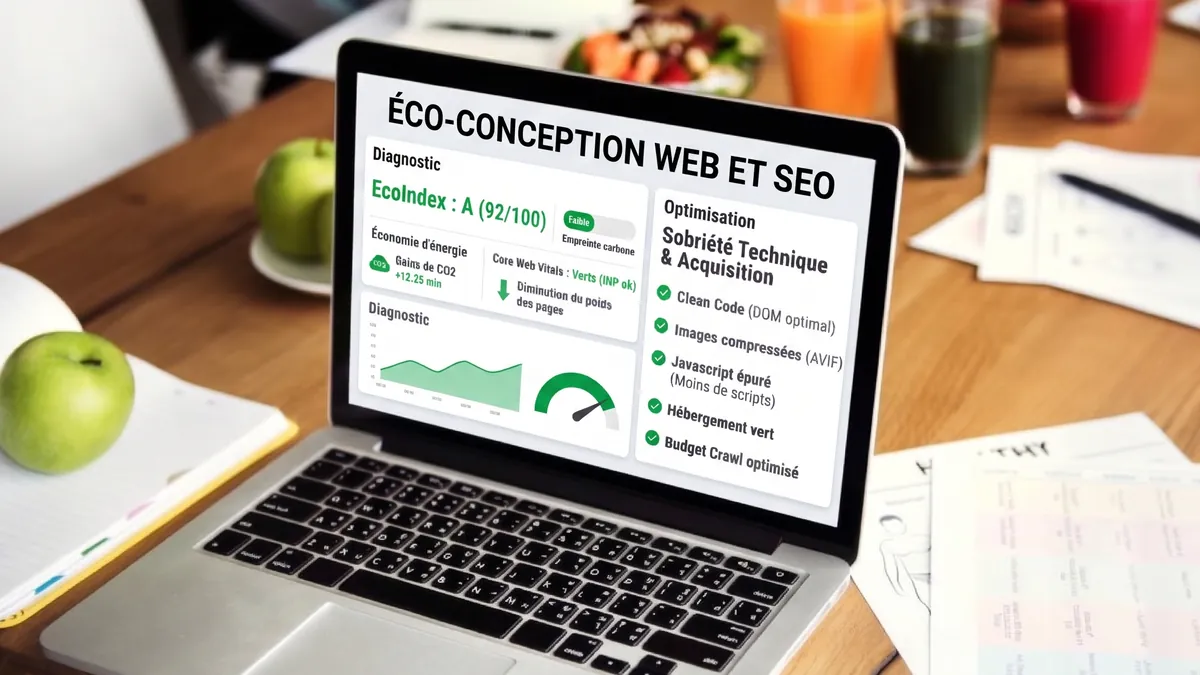
- Cutting the excess: an eco-designed website removes what serves no purpose: autoplay videos, uncompressed images (WebP or AVIF formats often halve their weight or more), heavy carousels that do not convert.
- The effect on crawling: lighter pages and a less loaded server respond faster, allowing Google to crawl more pages in the same time. The gain is mainly felt on large e-commerce catalogues; for a website of a few dozen pages, crawl budget is generally not an issue.
2. Clean code serving Core Web Vitals
Eco-design demands lean code. No more ageing themes or poorly optimised page builders that generate thousands of lines of code (an oversized DOM) to display a simple block of text.
- Less JavaScript: by limiting third-party scripts and removing unused code (CSS or JavaScript loaded by the theme but not used on the page), you reduce the work required of the visitor's phone or computer, and their battery thanks you.
- Better INP: this sobriety directly improves INP, Google's responsiveness metric, as well as display time. Core Web Vitals are among the ranking criteria, without being the most important: they do not replace good content, but with equal content the smoother website has the edge, and it converts better.
3. The CSR argument as a B2B reassurance tool
In B2B, more and more customers, led by large accounts and public bodies, have to report on their indirect emissions, including those of their suppliers (“scope 3”).
- A selection criterion: hosting powered by renewable energy, or an eco-design statement drawn up under the RGESN (the French government's general eco-design framework for digital services), is no longer anecdotal. It is an argument that can make the difference in a tender.
- A better experience for everyone: eco-design often goes hand in hand with accessibility (sufficient contrast, clear navigation, readable text). Google does not score accessibility as such, but a website that is easier to use keeps its visitors better and inspires trust.
Conclusion
The era of websites overloaded with visual effects that freeze the screen is coming to an end. Tomorrow's SEO favours light, durable architectures that are easy to maintain. It is the combination of profitability and responsibility.
Is your website so heavy that it holds back your traffic acquisition? Contact us for a technical eco-design audit and turn sobriety into a competitive advantage.
Frequently asked questions
Does Google favour eco-designed websites?
Not directly: there is no ecological criterion in its ranking. But eco-design improves the website's speed, responsiveness and clarity, which matter to Google as well as to visitors.
How can I measure my website's footprint?
The free EcoIndex tool gives each page a score from A to G. Page weight, the number of requests and DOM size are the main levers.
What is the RGESN?
It is the French government's general eco-design framework for digital services. It sets out best practices and a template eco-design statement, useful in particular for public tenders.

A website, SEO or another request?
Design, redesign, SEO, maintenance, AI assistant or just a question: let's talk. Free quote and quick reply.
Request a quote or contact us