Beyond text generation: how AI is transforming technical SEO and user experience

Using artificial intelligence to churn out articles has become common… and therefore ordinary: it no longer sets you apart. Google's policies explicitly target content produced at scale without added value, as we explained in connection with the latest spam update.
For B2B companies and ambitious online retailers, AI's real advantage no longer lies in creating text but in integrating it at the heart of the website. Here are three ways to use it to improve your website technically and boost your SEO.
1. Log analysis and crawl budget optimisation
Search engines devote limited time to crawling each website: this is the crawl budget. If Google's bots waste it on useless pages (endless filters, duplicates, old URLs), your important pages may be crawled less often, or even indexed late.
Analysing log files (the exact record of bot visits to your server) used to take hours of processing. Analysis tools now rely on machine learning to bring out anomalies quickly:
- Spotting leaks: redirect loops, error pages visited over and over, areas of the website that absorb most of the bots' attention without bringing anything back.
- Anticipating indexing: by comparing how often Googlebot visits each section, you can identify new pages likely to be discovered late, which deserve more internal links.
2. AI-assisted semantic internal linking
Internal linking (the links connecting your pages) is a pillar of SEO: it spreads authority across the website and guides bots to your content grouped by theme (“topic clusters”).
On a 50-page website, this can be done by hand. On an e-commerce catalogue or a 500-page blog, staying consistent becomes very difficult.
- Links based on meaning: AI can analyse all your content and suggest links to the most relevant pages, based on the topic rather than the mere presence of an exact keyword. Human validation is still advisable: an automatically inserted link in the wrong context does more harm than good.
- A better reading journey: offering the content that completes the reader's visit at the right moment extends the visit and increases the chances of an enquiry. Google does not use your analytics (bounce rate, time on page) to rank your pages, but a website that serves users better gains links, reputation and conversions over time.
3. Site search that understands natural language
User experience and SEO are now inseparable. One of a website's biggest friction points, especially in B2B or on a technical shop, is the internal search engine. If a customer is looking for an “M12 hex nut” but types “6-sided nut 12”, a basic engine will show “0 results” for lack of the exact words, and the buyer will go elsewhere.
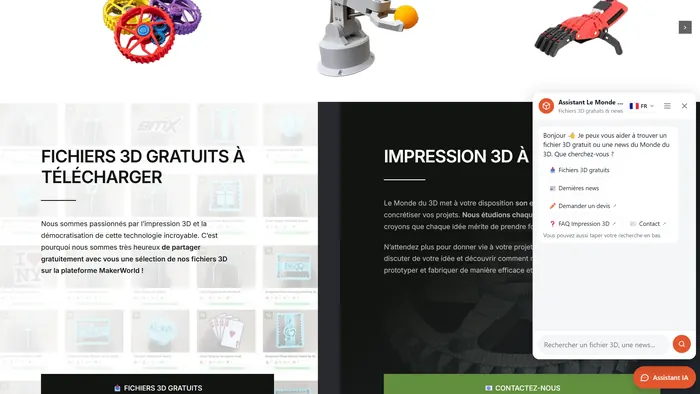
- Understanding intent: a site search based on natural language processing (NLP) understands synonyms, typos and above all the intent behind the query. An AI assistant can even talk with visitors to guide them.
- An impact mainly on conversion: a visitor who immediately finds what they are looking for buys or requests a quote more often. Queries typed into your site search are also a goldmine for SEO: they reveal your customers' words and the content you are missing.
Conclusion
Integrating artificial intelligence into your website is not about adding gadgets. It is about building a smart technical foundation that understands visitors and makes search engines' work easier. That is where tomorrow's SEO is played out, as the shift towards answers generated by Google's AI also shows.
Is your current website holding back your growth? Contact us to discuss a redesign of your website and the integration of next-generation SEO tools.
Frequently asked questions
Does my website have a crawl budget problem?
Rarely if it has a few dozen or a few hundred pages. It is mainly an issue for large catalogues and websites that generate many URLs automatically. The “Crawl stats” report in Search Console lets you check.
Can you let AI create internal links on its own?
It is better to use it to suggest links and then validate them. A badly placed link confuses readers and blurs search engines' understanding of the website.
Does smart site search improve SEO?
Indirectly. Its main effect is on conversion, but the queries your visitors type reveal the content to create, which feeds your SEO strategy.

A website, SEO or another request?
Design, redesign, SEO, maintenance, AI assistant or just a question: let's talk. Free quote and quick reply.
Request a quote or contact us