Google PageSpeed and SEO: what is the real impact on your rankings?
At a time when web speed shapes users' habits, technical performance has become unavoidable in SEO. Long seen as a mere detail, the Google PageSpeed Insights tool and the metrics it measures play a direct and indirect role in your visibility on Google. What exactly is the link between PageSpeed, Core Web Vitals and your rankings? Let's take a closer look.
1. What is Google PageSpeed Insights and what does it measure?
PageSpeed Insights (PSI) is Google's official, free tool for analysing how a web page loads, on mobile and desktop. It combines two complementary types of data:
- Lab data: a simulation run by Lighthouse in a controlled environment. It gives the famous score out of 100 and lists the points to improve.
- Field data: the performance actually experienced by visitors using Chrome, from the CrUX report (Chrome User Experience Report) over a rolling 28-day period. This is what Google uses to assess the experience of your pages.
Core Web Vitals, the heart of the assessment
Google assesses user experience through three key metrics, visible in PageSpeed and in Search Console:
| Metric | What it measures | “Good” threshold |
|---|---|---|
| LCP – Largest Contentful Paint | The time it takes to display the page's main content | Under 2.5 s |
| INP – Interaction to Next Paint | How responsive the page is when you click or type | Under 200 ms |
| CLS – Cumulative Layout Shift | Visual stability: elements that “jump” while loading | Under 0.1 |
Since March 2024, INP has replaced the old FID metric: it is more demanding, because it measures responsiveness throughout the visit, not just on the first click.
2. The direct link between PageSpeed and SEO
You hear everything and its opposite about the impact of speed. Let's set the record straight.
A real ranking factor…
Yes, page experience – including Core Web Vitals – is among the signals taken into account by Google's ranking systems. A very slow page with Core Web Vitals in the red starts at a disadvantage compared with its competitors.
… but a tie-breaker, not magic
A score of 95/100 will not propel mediocre content to first position. Content, its relevance and the website's authority remain the pillars of SEO. However, with equal relevance, a fast website has the edge over a slow one.
The amplifying effect of mobile-first
Google indexes and ranks websites based on their mobile version. Mobile conditions – less powerful processors, sometimes unstable 4G networks – are much more demanding. It is the mobile score you should watch first.
3. Indirect impacts: why speed changes everything for your traffic
- Visitors leave: the longer a page takes to display, the more users give up, especially on mobile. A lost visit is a potential customer going back to a competitor.
- Crawl budget: a slow server or heavy pages slow Googlebot down. On a large website, it explores fewer pages on each visit, which delays the indexing of your new content.
- Conversions: in e-commerce as for a quote request, every second saved improves the conversion rate. The less users wait, the more they act.
4. How to optimise your website for PageSpeed and Google
Optimise your images
They are often the heaviest elements. Resize them to the right size, compress them and use the modern WebP or AVIF formats. Lazy-load images further down the page, but never the main image visible on arrival.
Lighten the code
Remove unnecessary third-party scripts – useless plugins, social media widgets, duplicate tracking tools – that block the browser. Defer non-essential JavaScript and reduce CSS to what is needed.
Look after your fonts
Host your fonts on your own server, limit the number of weights, preload those used at the top of the page and reserve their space to avoid layout shifts (CLS).
Choose good hosting
A responsive server reduces TTFB (Time To First Byte, the delay before the first byte is received), which affects everything else in loading, starting with LCP.
Enable compression and caching
Compression (Gzip or Brotli) reduces the weight of the files sent, and browser caching saves visitors from downloading the same elements on every visit. On WordPress, a well-configured caching plugin makes a huge difference: we explain the method in our article on optimising a WordPress website.
A real example: guigout.com
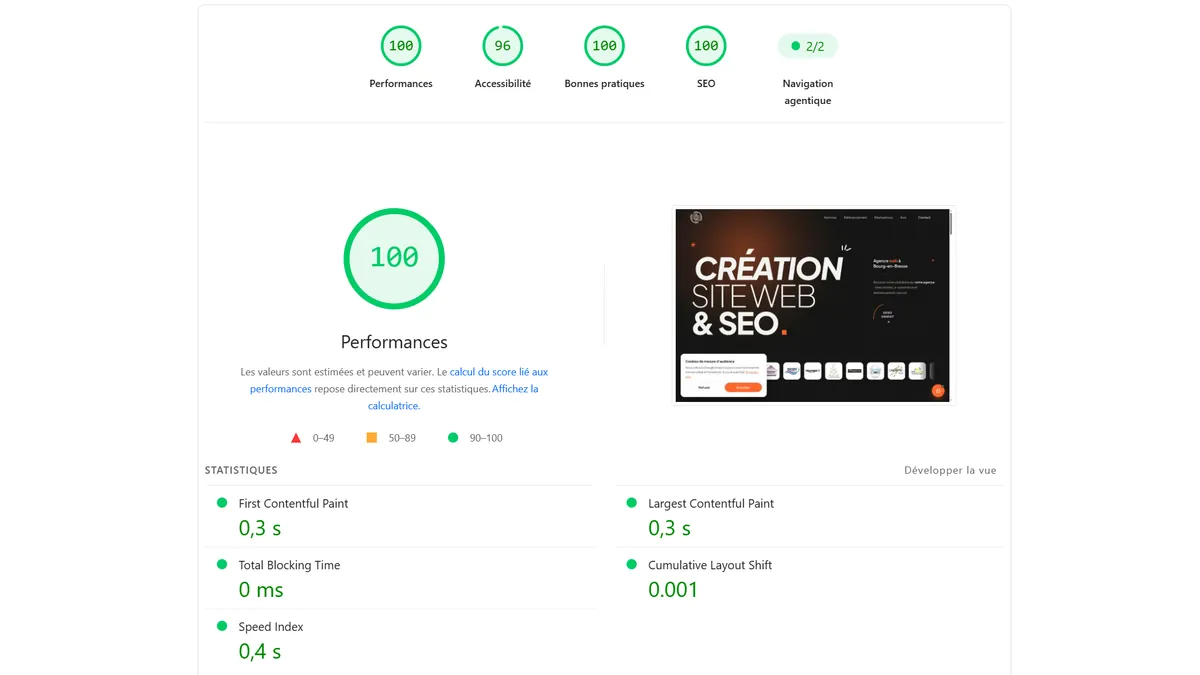
We apply these principles to our own website, which we rebuilt entirely without a CMS, with WebP images, locally hosted fonts and code kept to the bare minimum. The result in Lighthouse:
| Criterion | Score / measurement |
|---|---|
| Performance | 100 / 100 |
| Accessibility | 96 / 100 |
| Best practices | 100 / 100 |
| SEO | 100 / 100 |
| First Contentful Paint / Largest Contentful Paint | 0.3 s / 0.3 s |
| Total Blocking Time / Cumulative Layout Shift | 0 ms / 0.001 |
These figures are not an end in themselves, but they show that a modern, visually rich and animated website can remain extremely fast when performance is built in from the design stage.
Conclusion
The PageSpeed score should not be seen as a technical chore, but as an indicator of the health of your user experience. Aiming for 100/100 is not always necessary; on the other hand, reaching the “green” Core Web Vitals thresholds – especially on mobile – has become essential to gain and keep good positions on Google.
Frequently asked questions
Does a PageSpeed score of 100 guarantee first place on Google?
No. Speed is one factor among others. Content, its relevance and the website's authority remain decisive. With equal quality, however, a fast website has the edge.
Should I look at the mobile or desktop score?
The mobile score first: Google indexes and ranks websites based on their mobile version, and that is where performance gaps are most pronounced.
Why does my PageSpeed score change with every test?
The lab simulation varies slightly depending on server and network load at the time of the test. To assess the real experience, rely on field data (CrUX) and the Core Web Vitals report in Search Console.

A website, SEO or another request?
Design, redesign, SEO, maintenance, AI assistant or just a question: let's talk. Free quote and quick reply.
Request a quote or contact us