Search engine optimisation (SEO): definition, stakes and method
Search engine optimisation, or SEO, covers all the techniques that help a website appear among the top free results of search engines such as Google or Bing. It is one of the most lasting investments a business can make: a well-ranked website attracts customers day after day, without paying for each visit.
Why is SEO essential?
The most beautiful website in the world has no chance of being seen if it does not appear in search results. Yet the vast majority of clicks go to the top results on the first page. Ranking well means:
- being found at the precise moment a customer needs you;
- gaining credibility: a well-ranked website inspires confidence;
- getting regular, lasting traffic, unlike advertising, which stops when the budget runs out.
How does Google work?
- Crawling: bots browse the web by following links.
- Indexing: the pages discovered are analysed and stored.
- Ranking: for each search, hundreds of factors determine the order of results, with one goal: to provide the most useful and reliable answer.
The three pillars of SEO
1. Technical
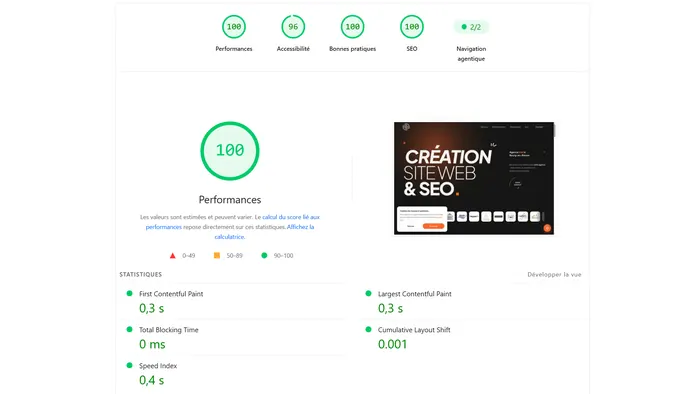
Your website must be easy to crawl and pleasant to use: fast, mobile-friendly, secured with HTTPS, error-free, with an XML sitemap and clean URLs. This is the foundation on which everything else rests.
2. Content
Each page must clearly match a search intent, with original, useful and well-structured content. Google particularly values real experience and expertise: your examples, your projects, your professional advice.
3. Popularity
Links from other websites, mentions of your business and your customer reviews are all signals of trust. They are built over time, with relevant partners and websites.
Local SEO, a decisive lever
For a business serving a specific area, searches such as “web agency Bourg-en-Bresse” or “plumber near me” are essential. They often display a map highlighting three businesses. To appear there, you need:
- a complete, active Google Business Profile listing;
- numerous, recent customer reviews;
- identical contact details on your website and everywhere else;
- pages that clearly mention the towns you serve.
SEO in the age of artificial intelligence
With AI-generated answers in Google and assistants such as ChatGPT, SEO gains a new dimension: being cited as a source. The basics remain the same – a solid website, reliable and well-structured content – but the quality bar is rising. We cover these changes in detail in our article on GEO.
How does an SEO audit work?
- Technical analysis: speed, mobile, indexing, errors, structure.
- Content analysis: pages, target keywords, tags, internal linking.
- Popularity analysis: links, reviews, local presence.
- Competitor analysis: who ranks for your keywords, and why.
- Prioritised action plan: the fixes and content that will have the most impact.
Optimise your website's SEO
Showcase website or online store, we analyse your website and propose an SEO strategy tailored to your business and your area, with over twenty years of experience with WordPress and WooCommerce.
Frequently asked questions
How long does it take to see the effects of SEO?
Generally several months, depending on the competition and the initial state of the website. The effects then last, provided the website and its content are maintained.
SEO or Google Ads?
The two are complementary: advertising brings immediate visibility, while SEO builds lasting visibility with no cost per click.

A website, SEO or another request?
Design, redesign, SEO, maintenance, AI assistant or just a question: let's talk. Free quote and quick reply.
Request a quote or contact us