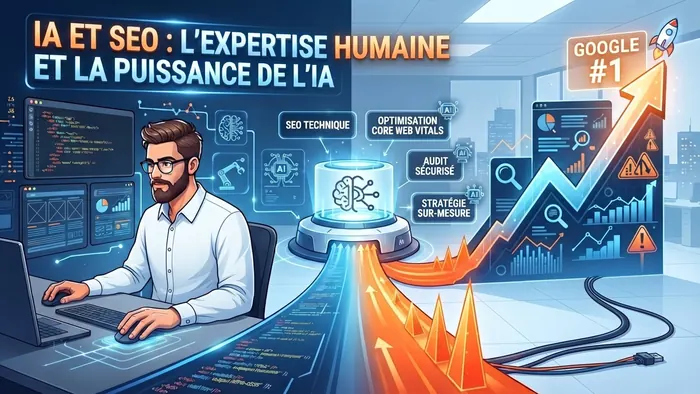
GEO: understanding and mastering SEO in the age of AI

Traditional SEO aimed for a place among Google's “ten blue links”. With the arrival of generative engines – Google's AI Overviews and AI Mode, ChatGPT Search, Perplexity, Copilot – a new discipline is emerging: GEO, for Generative Engine Optimization.
What is GEO?
GEO covers all the techniques aimed at making content or a brand visible in answers generated by artificial intelligence. The goal is no longer just to get a click, but to become the cited source or the main recommendation when a user asks an AI.
Why is it a revolution?
- “Zero-click” searches: users get their answer directly, without visiting a website. Pages that only offer simple information lose traffic.
- The value of a citation: being cited, with a link, in an AI answer brings highly qualified visibility. A user who clicks is already convinced of your relevance.
- Semantic authority: AI assesses the accuracy and reliability of information, not just a page's popularity as measured by its backlinks.
The 4 pillars of an effective GEO strategy
Pillar 1: write to be cited
Generative engines favour content they can reuse with confidence. In practice:
- include recent, sourced figures;
- draw on expert opinions and your own experience;
- phrase your arguments so they can be summed up in one sentence.
Pillar 2: clarity and structure
An AI must be able to “digest” your page quickly. Two main levers:
- Schema.org structured data, which explicitly describes your information: company, address, opening hours, products, prices, reviews, articles;
- a direct style: answer the question in the first paragraph, following the inverted pyramid, then go into detail.
Pillar 3: stronger E-E-A-T
Experience, expertise, authoritativeness and trustworthiness matter even more to AI, which discards generic or dubious content. To strengthen these signals:
- publish original case studies from your projects;
- clearly identify the author and the company behind each piece of content;
- build your reputation beyond your website: Google reviews, business directories, local press, specialist forums. AI cross-checks these sources to verify that a brand is genuinely recognised.
Pillar 4: multimodality
Recent models natively understand text, images and video. Write descriptive alt attributes for your images, use explicit file names and vary formats (text, short video, infographic) to increase your chances of appearing in rich answers.
SEO or GEO: what are the differences?
| Criterion | Traditional SEO | GEO |
|---|---|---|
| Goal | Rank a link on the first page | Become the source cited by AI |
| Key indicator | Rankings, click-through rate (CTR) | Share of citations, brand mentions |
| Preferred format | Optimised pages and articles | Structured facts, summaries, data |
| User expectation | Find a website | Get an immediate answer |
| Target engines | Google, Bing | ChatGPT, Perplexity, Gemini, Google's AI Mode |
Should you give up on SEO?
No, and this is the key point: GEO is an extension of SEO, not a replacement. AI relies heavily on pages that search engines have already indexed and judged reliable. A fast, well-structured, well-ranked website remains the starting point. Transactional searches (“get a quote”, “buy”, “book an appointment”) also continue to generate direct visits.
Ignoring GEO, however, means running the risk of becoming invisible to a whole generation of users who “chat” with information rather than scrolling through results.
Frequently asked questions
Are GEO and SEO the same thing?
No. SEO aims for a good ranking in search engine results; GEO aims to be cited in answers generated by AI. The two are complementary.
Where should you start with GEO?
With the basics: pages that clearly answer your customers' questions, structured data, accurate and up-to-date information, and a good online reputation.

A website, SEO or another request?
Design, redesign, SEO, maintenance, AI assistant or just a question: let's talk. Free quote and quick reply.
Request a quote or contact us