How to get your website ranked? The 7-step guide

A website, however beautiful, only truly exists if it can be found. Search engine optimisation (SEO) covers all the actions that help you appear in the free results of search engines. It is long-term work that keeps evolving, but its fundamentals remain the same. Here are the seven essential steps.
1. Choose the right keywords
Keywords are the phrases your customers type – or say – to find what you offer. To identify them:
- list the questions your customers ask you on the phone or in meetings;
- think local: “landscaper Bourg-en-Bresse” is less competitive than “landscaper” and attracts far more relevant customers;
- use tools such as Google's suggestions, Search Console or the Google Ads Keyword Planner;
- focus on one main phrase per page, along with its natural variants.
2. Create quality content
Google aims to provide the best answer to every search. Your content should therefore be:
- useful: it genuinely answers the question asked;
- original: it brings your experience, your examples, your photos;
- readable: clear subheadings, short paragraphs, lists;
- up to date: prices, opening hours, services and practical information kept current.
3. Optimise every page
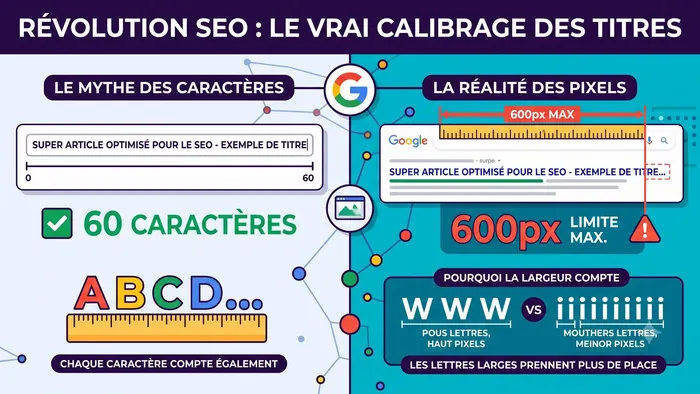
- The title tag: unique for each page, with the keyword at the start (see our article on title width in pixels).
- The meta description: a compelling summary of about 150 characters.
- A single H1 heading, followed by well-structured H2 and H3 headings.
- Short, readable URLs (/showcase-website/ rather than /?p=123).
- Compressed images in WebP format, with a descriptive alt attribute.
- Internal links between your pages to guide visitors and bots.
4. Take care of the technical side
The best page in the world will not rank if it is slow or poorly indexed:
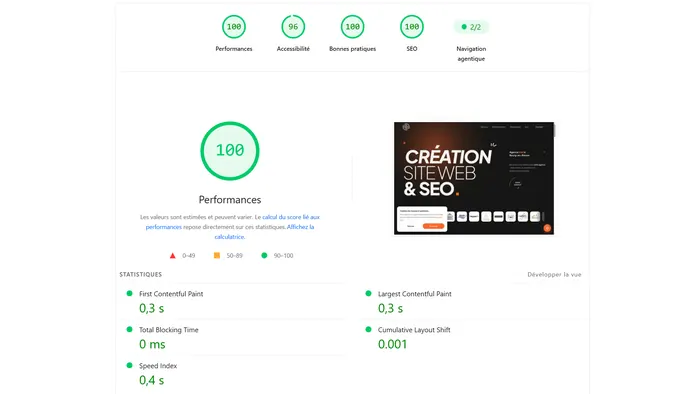
- a fast website that meets Google's Core Web Vitals;
- a mobile-friendly website: Google now evaluates your site based on its mobile version;
- HTTPS enabled everywhere;
- an XML sitemap submitted in Google Search Console;
- no 404 errors or duplicate content.
5. Earn quality links
Links from other websites (backlinks) remain an important signal of trust. But quality matters far more than quantity: a link from your chamber of trade, a supplier, a local partner or the regional press is worth much more than dozens of links bought on unrelated websites. Artificial techniques can even lead to penalties.
6. Work on local SEO
For a business serving a specific area, this is often the most profitable lever:
- create and complete your Google Business Profile listing (opening hours, photos, services, categories);
- regularly collect customer reviews and reply to them;
- keep identical contact details everywhere (website, Google listing, directories, social networks);
- mention the towns you serve in your content.
7. Measure and adjust
SEO is driven by data:
- Google Search Console shows the queries that bring you visitors, your rankings and any indexing problems;
- Google Analytics shows what visitors do once on the website;
- every month, analyse the pages that are progressing and those that are stagnating, then adjust.
How long does it take to rank well?
Generally allow several months to see significant results, depending on the competition in your sector and your website's history. SEO is a long-term investment: unlike advertising, its effects last once the work has been done.
Frequently asked questions
Is SEO free?
Clicks are free, unlike advertising. However, creating content, optimising and monitoring takes time or the support of a professional.
Do you need to submit your website to Google?
Google discovers websites on its own, but submitting your website and sitemap in Google Search Console speeds up indexing and gives you access to valuable data.

A website, SEO or another request?
Design, redesign, SEO, maintenance, AI assistant or just a question: let's talk. Free quote and quick reply.
Request a quote or contact us