E-commerce SEO: the 4 pillars to turn your WooCommerce catalogue into a sales machine
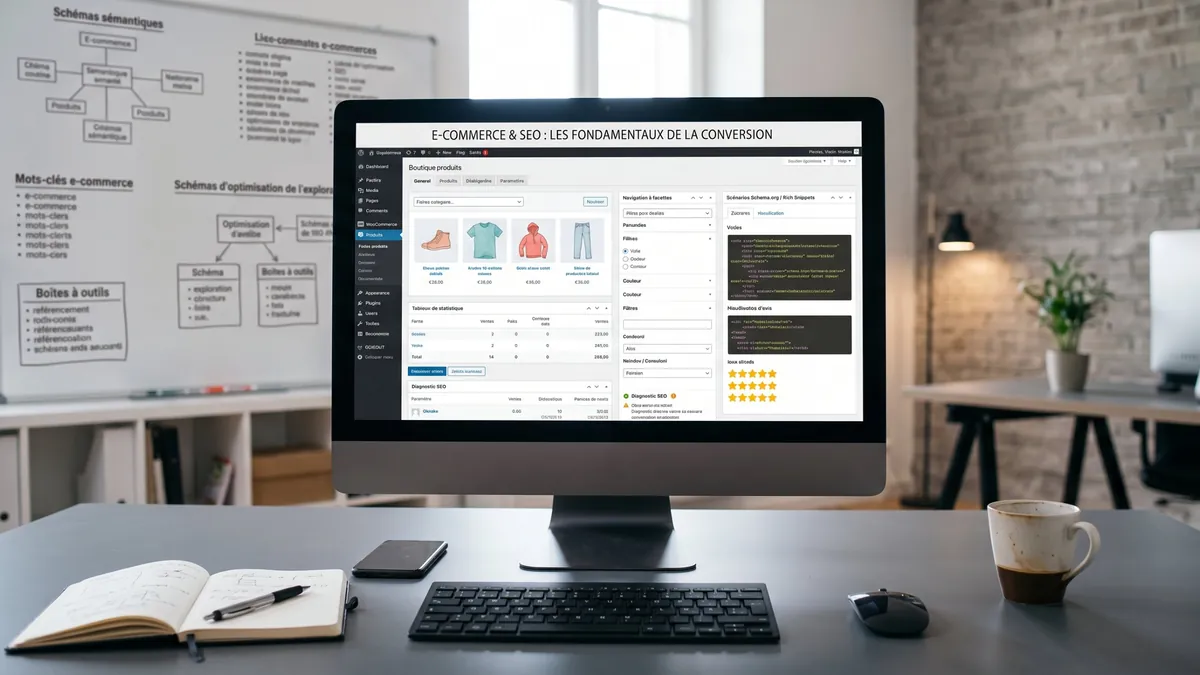
Launching an online shop has never been technically easier, but getting it into Google's top results has never been more demanding. E-commerce SEO does not follow the same rules at all as SEO for a showcase website.
Where a corporate website has a few dozen pages, a WooCommerce shop often has to manage hundreds or even thousands of products, variations and filters. If your catalogue is stagnating and your sales depend solely on paid advertising, here are the 4 priority SEO projects to take back control of your organic traffic.
1. The faceted navigation trap (filters)
This is one of the most common technical mistakes on online shops. To help visitors, you offer filters: size, colour, price, brand. Excellent for usability… but a real headache for search engines.
- The duplicate content problem: every time a filter is clicked, the page address changes (for example
/shoes/?colour=red&size=42). Without precautions, Google may crawl thousands of near-identical pages. This is not a penalty, but your crawl budget is wasted and the strength of your pages is diluted across a multitude of duplicates. - The technical solution: decide which combinations deserve to be indexed (often none, sometimes a few highly searched ones, such as a specific brand) and handle the others. The canonical tag indicates the reference version, the noindex directive excludes a page from the results and the robots.txt file prevents crawling. Your main categories remain open to indexing.
2. The supplier description trap
When adding 500 new products, it is tempting to copy and paste the manufacturer's descriptions. It is a strategic mistake.
- No differentiation: if you use the same text as your 50 competitors and the manufacturer itself, Google has no reason to feature you. There is no penalty, but it will generally choose to show just one of these identical pages, rarely yours.
- Product pages that add something: every strategic product page needs unique content. Write your own descriptions and add value: usage tips, expert opinion, product-specific FAQs. The goal: capturing highly qualified long-tail searches. Start with your best sellers, where the effort pays off most.
3. The underestimated power of category pages
Many online retailers focus on the home page or product pages and forget category pages. Yet these are often your most powerful landing pages.
- Capturing generic intent: users rarely search for the exact reference “Facom 113A.10C adjustable wrench”. They type “professional adjustable wrench”. Your category page is the one that should rank for that search.
- Editorial content: a category page should not be a mere grid of images. It deserves useful text (a short introduction at the top, fuller content at the bottom so as not to get in the way of browsing), a clear H1 title, relevant subheadings and links to your flagship products and related categories.
4. Structured data to improve click-through rate
Ranking well is good. Convincing users to click your link rather than the competitor's just below is better. That is the role of structured data (Schema.org), which enables rich results.
- Rich display: thanks to the Product markup on your product pages, Google can show the price, availability (in stock or not) and customer review rating directly in its results. WooCommerce already generates basic markup; a well-configured SEO plugin completes it. Google alone decides what to display, however, and nothing is guaranteed.
- The impact on sales: a result with stars and a price catches the eye and often improves click-through rate. Check that your markup is valid with Google's Rich Results Test and track your clicks in Search Console.
Summary
| Project | The problem | The solution |
|---|---|---|
| Filters | Thousands of near-identical pages | Canonical, noindex or robots.txt, case by case |
| Product pages | Text copied from the manufacturer | Unique descriptions, tips, FAQs |
| Categories | Mere grids of images | Useful text, clear H1, internal links |
| Structured data | Plain search results | Product markup: price, stock, reviews |
Conclusion
E-commerce SEO is precision mechanics: a technically poorly configured WooCommerce shop will struggle to take off, even with excellent products. Also think about your WordPress website's speed and, for personalised products, an ordering journey suited to custom-made products.
Are your product pages struggling to attract organic traffic? Contact us for a full technical audit of your WooCommerce shop. With more than 20 years of experience, we will identify what is holding back your sales and put a profitable growth strategy in place.
Frequently asked questions
Should filter pages be indexed?
Generally not. Only a few highly searched combinations (a brand, a specific use) deserve to be indexed, with real content. The others should be excluded with a canonical tag, noindex or robots.txt, without mixing these methods on the same pages.
Can you keep the manufacturer's descriptions?
For secondary products, it is acceptable in the short term. But for your flagship products, a unique, enriched description makes the difference against competitors selling the same thing.
Does WooCommerce handle structured data?
Yes, it generates basic Product markup (name, price, availability, reviews). An SEO plugin can complete it. Google's Rich Results Test lets you check that it is valid.

A website, SEO or another request?
Design, redesign, SEO, maintenance, AI assistant or just a question: let's talk. Free quote and quick reply.
Request a quote or contact us