Mobile app: should you develop for iOS, Android, or bet on the web (PWA)?
Internet traffic is now mostly mobile: the question is no longer whether your business should be on smartphones, but how. For many brands, the first instinct is to “build an app” for the App Store (Apple) and the Google Play Store (Android).
Yet in a saturated market, the choice of technology (native, hybrid or web) is a strategic decision. It directly affects your budget, your technical maintenance and, above all, how you acquire customers, especially through organic search.
1. The native app (iOS and Android): the loyalty weapon
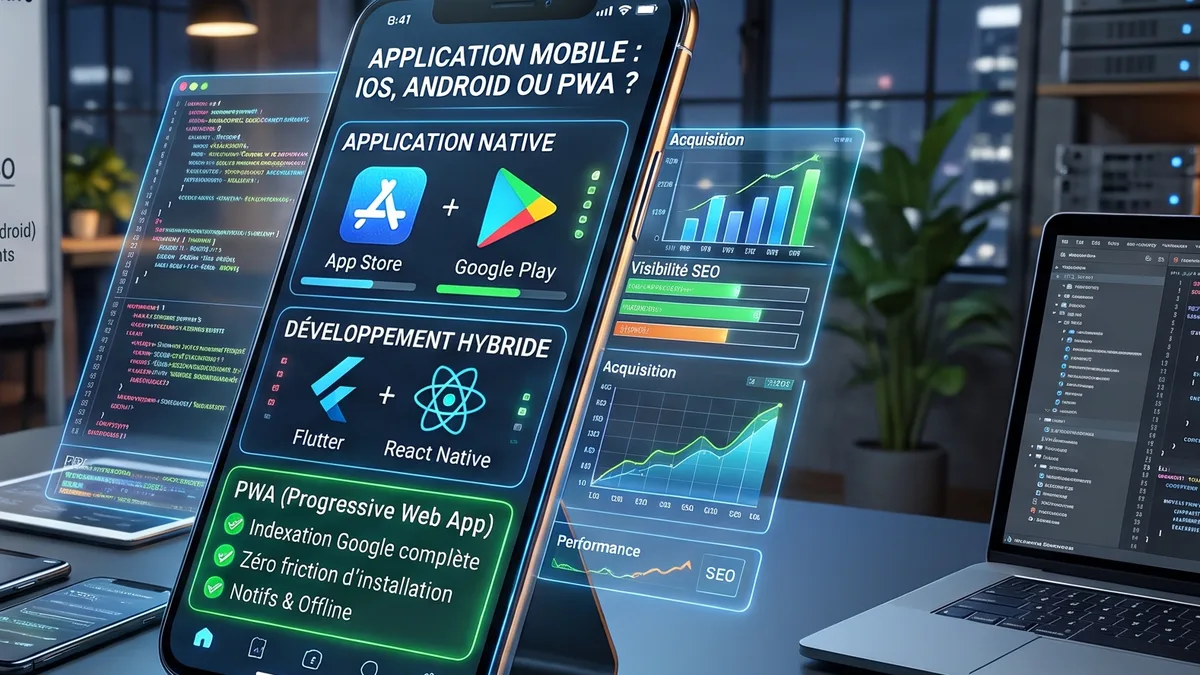
Developing “natively” means coding two separate apps with each system's own language: Swift for Apple, Kotlin for Android.
- The best user experience: this is the solution with the best performance. The app makes full use of the phone's capabilities (camera, background GPS, Bluetooth, Face ID) with great fluidity.
- The acquisition trap: a native app is a closed world. Its content is not indexed by Google like the pages of a website: it brings you almost no organic search traffic. Acquisition relies on ASO (App Store Optimization, ranking within the stores) or advertising, which can quickly become expensive.
- The verdict: native is ideal for loyalty. It is a sensible choice if you already have a solid customer base that will use your service regularly (banking, daily management tool, major e-commerce brand).
2. Hybrid development (Flutter, React Native): the budget compromise
To avoid funding two development teams (one for iOS, one for Android), many projects turn to so-called cross-platform or hybrid frameworks.
- One codebase, two platforms: with Flutter (created by Google) or React Native (created by Meta), most of the code is written once and then runs on both iPhone and Android.
- Advantages and limits: development cost and time are significantly reduced, and performance is sufficient for the vast majority of business needs (shop, service app). But you remain dependent on Apple's and Google's stores: strict review processes and a commission of up to 30% on sales of digital content and services (subscriptions, in-app purchases). Sales of physical products are not affected.
3. The PWA (Progressive Web App): SEO's ally
What if the best app was not in the stores, but directly on the web? A PWA is an optimised website that behaves like an app once opened on a phone.
- The big SEO advantage: unlike traditional apps, every page of a PWA has a regular address (URL). It can therefore be crawled and indexed by Google: you combine the experience of an app with the acquisition power of organic search.
- Less friction for users: no store, no heavy download. Visitors land on your website and can add it to their home screen: on Android, the browser often suggests it automatically; on iPhone, it is done via the “Share” menu, then “Add to Home Screen”.
- Advanced features: a PWA can work offline thanks to caching, send notifications (on iPhone, once added to the home screen) and offer excellent responsiveness, provided it is well optimised, as measured by INP, Google's responsiveness metric.
Conclusion
The golden rule of mobile is simple: the web (and SEO) is for acquiring customers, the app is for keeping them. If your main goal is to gain visibility and new customers, investing tens of thousands of euros in an isolated native app is rarely the right calculation. A PWA or a website perfectly optimised for mobile often remains your best asset. To go further, see also our article website or mobile app: how to choose.
Unsure about the technical architecture of your next mobile or web project? Contact GUIGOUT SAS for a feasibility study: together we will define the most cost-effective technology for your acquisition.
Frequently asked questions
Is a PWA visible in the App Store or Google Play?
Not by default: it installs directly from the browser. It can be published on Google Play, and under conditions on the App Store, but this is not necessary to use it.
Is a native app indexed by Google?
Its store listing can appear in search results, but its content is not indexed like website pages. That is why a website remains essential for visibility.
Which solution is the cheapest?
Generally the PWA, since it builds on your website. Hybrid comes next, then native, which requires two separate developments and two maintenance efforts.

A website, SEO or another request?
Design, redesign, SEO, maintenance, AI assistant or just a question: let's talk. Free quote and quick reply.
Request a quote or contact us