SEO and conversational AI: how to position your website in the age of AI
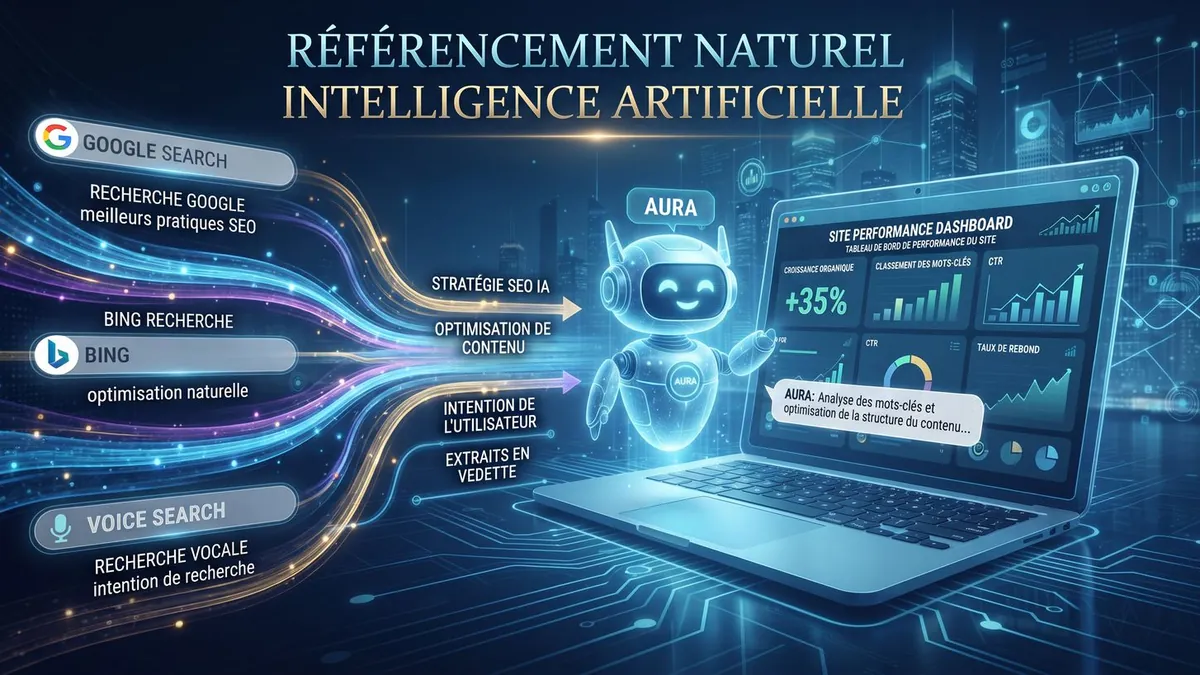
For twenty years, search engine optimisation meant climbing a list of blue links. Today, a growing share of users ask their question directly to a conversational assistant – ChatGPT, Claude, Gemini, Perplexity or Google's AI Mode – and get a written answer, sometimes without ever visiting a website. For a business, the goal is changing: it is no longer just about getting a click, but about being the source the AI chooses to cite.
1. From search engines to conversational assistants
The classic “query → list of results → click” journey is gradually giving way to a three-step exchange:
- A question in natural language: users no longer type “plumber Bourg-en-Bresse”, they ask “Which plumber can come quickly in Bourg-en-Bresse to fix a leak under the sink?”.
- An instant summary: the assistant reads several web pages and extracts the essentials.
- Cited sources: the answer comes with links to the websites judged most reliable.
The direct consequence: a confusing, generic website that is hard for a machine to read is simply ignored in favour of a clearer competitor. Conversely, a website that provides reliable, precise information can be cited ahead of much bigger players.
2. Why AI favours some websites over others
Large language models do not work like an old-fashioned ranking based on keyword density. They rely on an overall semantic understanding of the pages they read. Three qualities make the difference.
Unique information
A page that rephrases what can be found everywhere adds nothing for the AI: it can already do that itself. What interests it is first-hand data: your figures, your indicative prices, your real lead times, your feedback, your analyses. That is precisely what no other website can provide in your place.
A clear structure
Hierarchical headings (H1, H2, H3), logical lists, summary tables and short paragraphs allow the AI to extract a fact without ambiguity. A long block of text without subheadings is much harder to use.
Demonstrated expertise
A website that regularly publishes in-depth, consistent content on its subject strengthens its credibility. The E-E-A-T signals (experience, expertise, authoritativeness, trustworthiness) that Google values also matter to assistants: an identified author, full contact details, customer reviews, mentions on other websites.
3. Four practical levers to get cited by AI
Focus on high-value content
Forget articles written “for volume”. Favour:
- case studies of your own projects, with the context, the solution and the results;
- well-argued expert opinions, even if it means taking a stand;
- your working methods, explained step by step;
- precise answers to the questions your customers actually ask you.
Adopt an “answer first” structure
Phrase your subheadings as questions, then answer directly in the first sentence of the paragraph before developing the nuances. This is the inverted pyramid used by journalists, and it is exactly what assistants look for to build their answers.
Take care of the technical architecture
- Add Schema.org structured data (organisation, article, product, review) to describe your content.
- Check that your
robots.txtfile does not accidentally block the bots you want to welcome (Googlebot, Bingbot, but also GPTBot, ClaudeBot or PerplexityBot depending on your strategy). - Keep pages fast and readable without JavaScript: content loaded late may escape some bots.
Use AI as a working partner
Assistants are also excellent tools for improving your website: analysing a page's structure, spotting the questions it does not answer, suggesting an article outline based on your customers' real intentions or checking the semantic coverage of a topic. Expertise and proofreading remain human; AI speeds up the work.
4. How to measure your visibility in AI answers
This is still new territory, but a few indicators can already be used:
- referral traffic from chatgpt.com, perplexity.ai or gemini.google.com in Google Analytics;
- regular tests: ask assistants your customers' questions and note whether your website is cited;
- the trend in branded searches in Search Console: being cited by an AI often makes people want to look you up afterwards.
In summary
AI does not mean the end of SEO: it redefines excellence on the web. Mediocre or purely automated content will lose its value, since AI can produce it itself. The websites that win will be those that focus on authenticity, accurate information and an impeccably organised structure.
Frequently asked questions
Is traditional SEO still useful in the face of AI?
Yes. Conversational assistants rely heavily on pages that rank well in search engines. Good SEO remains the foundation for being cited.
Should you block AI bots in robots.txt?
It depends on your strategy. Blocking them protects your content but deprives you of citations in answers. For a local business looking for visibility, it is generally better to allow them.

A website, SEO or another request?
Design, redesign, SEO, maintenance, AI assistant or just a question: let's talk. Free quote and quick reply.
Request a quote or contact us