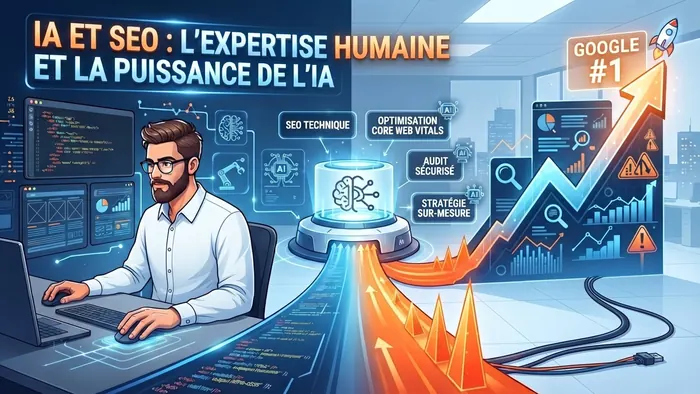
From SEO to GEO: how AI agents are redefining search optimisation
In 2026, SEO is undergoing a profound transformation: after analysis software come AI agents. Where a traditional SEO tool produced a report to read and apply, an agent can chain several actions on its own. This change opens up real possibilities… provided you stay in control.
What is an AI agent applied to SEO?
An AI agent is a program that observes its environment – your pages, search results, competitors, trends – then carries out multi-step tasks with limited human intervention. The difference with traditional tools is clear:
| Criterion | Traditional SEO tool | AI agent |
|---|---|---|
| How it works | You run the analysis | It suggests and acts on its own |
| Result | Recommendations to apply | Fixes made or prepared |
| Scope | An isolated task (finding a keyword) | A sequence: audit → fix → check |
| Evolution | Fixed | Adapts to results and search engine changes |
Tasks entrusted to AI agents
Technical optimisation
- Performance: spotting images that are too heavy, unnecessary scripts and resources that slow down display, and suggesting fixes.
- Crawling: detecting orphan pages, 404 errors, redirect chains or useless pages that waste crawl budget.
- Structured data: generating Schema.org markup consistent with each page's content.
GEO-oriented writing
Agents help turn a list of keywords into structured answers to users' real questions, suited to conversational assistants. They can also check that content demonstrates genuine experience (the first “E” in E-E-A-T) and flag passages that are too generic.
What this changes for strategy
As answers generated directly in search engines grow, “zero-click” searches increase. Three goals become more important:
- Being cited among the sources of AI answers, not just ranked first.
- Anticipating: continuously monitoring rankings, competitors and weak signals to react before a drop.
- Earning relevant links: favouring links from websites genuinely close to your topic rather than chasing authority scores.
The limits to be aware of
- Confident mistakes: an agent can state false information with assurance. Fact-checking remains essential.
- Generic content: mass-publishing automatically generated text adds nothing, and Google penalises content produced at scale without added value.
- Security: giving an agent access to a website's back office requires limited permissions, backups and oversight of its actions.
Conclusion: AI as the engine, humans as the pilot
AI agents are becoming a very useful extension of the SEO expert: they handle repetitive work and monitoring, making it possible to move from a reactive to a preventive approach. But on a web saturated with machine-generated content, value comes from what an AI cannot invent: real-life experience, well-argued opinions and fact-checking.
The right division of roles: let AI take care of structure, speed and semantics, and spend the time saved on what really makes the difference – your relationship with your customers.
Frequently asked questions
Can an AI agent replace an SEO agency?
No. It automates tasks, but strategy, trade-offs, approval of changes and the creation of genuinely expert content remain human.

A website, SEO or another request?
Design, redesign, SEO, maintenance, AI assistant or just a question: let's talk. Free quote and quick reply.
Request a quote or contact us